UltraPod Mini Tripod

Ultrapod 

I’ve blogged about a number of tripods in the past, window mounted tripods, walking stick tripods, and even tripods made out of string, but when it’s all said and done the tripod that I use the most is the venerable UltraPod. It’s small and folds shut, it’s got a Velcro strap to wrap around posts and such, and a ball head to point your camera in the right direction. Now it’s not perfect, many times the side of the ball joint will stop you from getting just the angle you want but because of the strap you can try to get a better orientation. Barring that, for the price it’s a perfect thing to have in your camera bag for those slow shutter speed exposures.

[via OhGizmo! and Coolest-Gadgets]

UltraPod Mini Tripod

Subwoofer of the Gods

60 inch subwoofer

I’m not a big fan of cars with woofers so loud that their cheap chrome trim rattles lose but this speaker is worthy of respect:

Unfortunately, Tim and his crew didn’t realize just how much acoustical power the sub could generate, and didn’t build the vehicle to contain it appropriately. Even at less than 1/2 output, the doors were blown off the tracks, and the entire vehicle ballooned in and out several inches.

That is one hell of a speaker!  

[via OhGizmo]

The 60 inch subwoofer

HDRI – a photoset on Flickr

I was browsing my favorite links  when I discovered an enchanting selection of HDRI (high dynamic range imaging) images of Japan. I’m working on a few of my own using a PC tool called Photomatrix. So far it’s been easier to use than the tool in Photoshop CS2. It provides better control over your image when your stacking the images up. The tone mapping of RAW images looks unbelievably impressive, I figure that I’ll have to go back and re shoot a bunch of my photos with this method. Sounds like a good excuse to go back to Toronto, New York, Japan and Bangkok. 🙂

[discovered via Nipponkan

HDR – a photoset on Flickr

Rube Goldberg, Japenese Style – ??????

??????

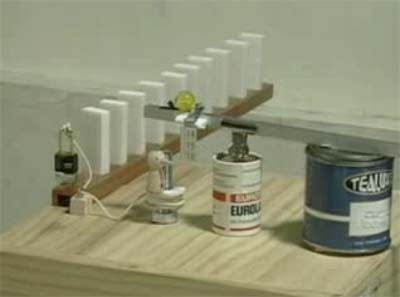
If you can do a task in a more complicated and convoluted fashion than a normal person would then you should be acquainted with these devices. The Japanese call them pitagora souchi, but we call them Rube Goldberg machines.
My brother sent this link to me yesterday. These examples are quite fascinating, the use of household items like spoons and paper clips is very inspirational.

Incredible Machines – Google Video

Vertibird 3D Simulator

Vertibird

I can’t tell you how happy I am to see this toy once again, even if it is a simulator. Growing up in the heyday of the Apollo space program, any toy that gave you your very own CM (Command Module) to recover from the carpet sea was instant gold. I don’t know what I miss more, the Vertibird or the safety orange reminder of the space race. Who would have known that a toy that just flew in a big circle and hooked things off the floor would be so much fun. If your like me, you played with it on a carpeted floor. I think the instructions said that you should never use it on anything but a smooth non-carpeted floor because the drive shaft will get gummed up with fluff and will ground your Vertibird until your Dad comes home and takes the tweezers to it. That is unless you did it yourself and as a result gained and intimate working knowledge of how flex shafts worked. 🙂

I suppose that is you could build the power transmission in the base you could build your own. Everything was cable controlled. The direction of the Virtibird was done by applying a twist to the long support arm that pitched the nose either up or down. I’m not too sure how the power was varied, that might have been done with a potentiometer in the control unit. Might be worth it, it did take a bit of skill to pick things up, especially if you had an oscillating fan in the room to simulate gusting winds. If you would like to know more about building your very own Vertibird, take a look at the build your own project page. Or if your lucky you might be able to find one that has been retired by a science museum.

[via MAKE

Mattel Vertibird 3D Simulator