Sensorama: Virtual Reality from 1962

Sensorama Who says that virtual reality is anything new? Inventor and cinematographer Morton Heilig had a firm grip on it back on the early 60’s:

(Sensorama was) an immersive 3-D virtual reality motorbike ride, in a form factor resembling an arcade game. Heilig saw Sensorama as the future of cinema, an immersive experience, complete with nine different fans to simulate the wind blowing on the user’s face, vibrating seat (to simulate driving over cobblestones), and the aromas of jasmine and hibiscus as the driver passed a flower garden, or the smell of baking pizza as one passed by an Italian restaurant in Brooklyn. (Rheingold, 1991) It never received the funding necessary to scale up to commercial production, and quietly disappeared, although Heilig persisted, patenting improvements over the next decade.

[viaNeatorama]

Morton Heilig’s Sensorama

EasyStill Home Alcohol Making Kit

EasyStillIf your as lazy as I am the idea of not having to drive down to the local liquor store to get a bottle of booze is quite appealing. How cool would it be to have a distillery in your back room?
EasyStill is a tabletop distillation unit. 4 liters of mash or wine are added and the unit plugged in. No cooling water required no thermometer or other nuisance. The unit is fan cooled. If you forget the unit it switches itself off when the boiling vessel is empty. Warming up takes one hour, and then distillation takes 3 hours. This gives 1.4 liters of spirits of approximately 46% alcohol. Active charcoal purification takes place during distillation through a 500mm purifying tube. The spirits produced have the flavour of vodka and are ready to drink or flavour with essences or herbs. Those choosing the easy way connect up a timer so the process looks after itself.

[via ohqizmo]
EasyStill

DIY Wet Cell Battery

Nice project, and best of all pretty safe.

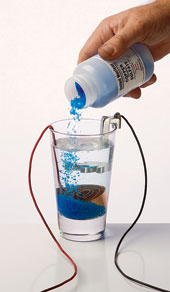
One particularly photogenic type of battery was known as a “gravity cell,” because gravity is what held it together. Typically used to power telephone and telegraph circuits, it consisted of a solution of blue vitriol (known these days as copper sulfate and sold in garden centers for pond treatment) on the bottom and a layer of zinc sulfate on top, kept separate only by their slightly different densities.
At the top, the electrode gives off zinc ions, while at the bottom, copper sulfate is reduced into copper metal. Together these complementary reactions produce just over one volt; string five batteries in series, and you get enough power to run a flashlight or charge an iPod. Any movement disturbs the delicate layers, ruining the battery, but if you’re careful, you can drop in new crystals of blue vitriol as needed, and the battery will run for years.

Copper sulfate is fun to play with by the way. If it’s heated to drive out moisture and left to cool you get a nice exothermic reaction when you add a drop of water to the pile of powder. Your not going to heat a meal but it does produce a little steam.

[via MAKE]
Popular Science Gray Matter – Build your own battery

Otona No Kagaku Crystal Radio Kit

Otona no Kagaku Crystal RadioOtona No Kagaku, or ‘Science for Adults’ is a ‘mook’ series published by Gakken in Japan. Each issue has includes a kit that goes along with whatever the issues topic is. I could hardly wait for this one! It’s a crystal radio. Very classy design too, that diamond weave coil design is a real eye catcher. It includes a diode that you can use as a detector or if your feeling like playing with the cat’s whisker a bit you can use the tow mineral samples. The reception isn’t as good as with the diode but you get the true crystal experience with this method. In the base of the radio is a small battery operated amplifier so you can use the radio without a super long antenna. I don’t think it’s cheating, your still using a chunk of rock to rectify the signal. It took me about two hours to put everything together and that’s with a few false starts in winding the coil. As my Japanese is very bad, I did have to look up the characters for some basic colors so I could connect the wires in the right order. This page on about.com proved to be quite useful with this. Now, the selectivity isn’t the best but that can be fixed with a little tinkering under the hood. It does receive the local stations quite nicely and best of all it just looks dead on cool. I took loads of photos of the build to have a gander at them and enjoy.

Otona No Kagaku Crystal Radio Kit build  – Flickr photoset

Karakuri Corner

Translated version of the Otona no Kagaku web site

Otona no Kagaku group on Flickr

VictorioNixie Tube POV Display

 VictorioNixie Tube I’m liking the looks of this…

This "electrochemical and electromechanical apparatus for the display of illuminated messages" is really a (heavily) modified persistence-of-vision toy. This toy was a pen i picked up at the local pharmacy (Walgreen’s) with a spinning head that displayed whatever message you programmed in. It was only $5.00, so i picked up a couple and let my imagination fly.
This is by far the most sculptural of all my creations, as it really serves no practical purpose 🙂
All in all, it cost me about $20US and two weeks worth of spare time (about 10 hours)
To see the device in action, go to:
www.youtube.com/watch?v=9BMAc6 jfG0M

[via brassgoggles]
VictorioNixie Tube – a photoset on Flickr

MindGuard – Psychotronic Protection


Well… this is, er… different…

Welcome to the MindGuard website, your source for the award-winning MindGuard family of anti-mind-control software for Amiga and Linux computers. Developed by Lyle Zapato during the psychotronically turbulent early 1990s, MindGuard offered Amiga-using paranoids the world over a new opportunity to think free of evil influences using advanced Active Anti-Psychotronic (AAP) software, theretofore only available to mind-control agents and paranoid millionaires. At the dawn of the Third Millennium, MindGuard was made available for even the stingiest paranoids with the introduction of MindGuard X for the free Linux OS. Now no one has an excuse not to be mind-control free!

This could be one of those rare times that I’m happy not running a Linux box at home, I’d be temped to try this. Then again, if it was good for the Amiga maybe I should have a look at it.
Anyway, I always thought the word ‘Psychotronic’ was used to describe real bad grade Z movies like ‘Plan Nine From Outer Space‘ (still the only film I’ve ever rented and couldn’t finish before I had to turn it in).

[via presurfer]
MindGuard Home Page