Millimeter Wave Active Denial System

Ouch! The effect of this device is to make it feel like your being melted.

The ADS shoots a beam of millimeters waves, which are longer in wavelength than x-rays but shorter than microwaves — 94 GHz (= 3 mm wavelength) compared to 2.45 GHz (= 12 cm wavelength) in a standard microwave oven.

I wonder if I can get one in a flashlight form factor… 


Say Hello to the Goodbye Weapon


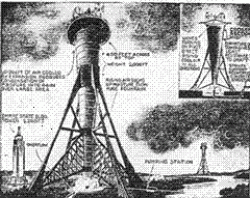
Air Wells, Dew Ponds and Fog Fences

Air Wells, Dew Ponds and Fog Fences


My friend Greg sent this to me the other day. It’s a great read if your into water, which I can safely say we all are. The article is quite through on the many aspects of gathering the moisture in the air and even inducing precipitation (although I don’t think I’d bet the farm on the Orgone methods).

Air Wells, Dew Ponds and Fog Fences: Methods to Condense Atmospheric Humidity

The Rolamite

Rolomite

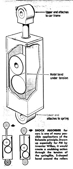
I think I’ve seen something a bit like these in tape drives and floppy drives, but then again maybe not. A Rolamite is a metal tape and a set of rollers that have some simply fascinating properties, like almost no friction and a natural tendency to store energy. A fine example of a practical use is this letter scale. I wonder if this might have a use in robotics…

[via Boing Boing]

Frictionless Machines from Rollers & Bands – The Rolamite

Audio Signals on a TV Mod

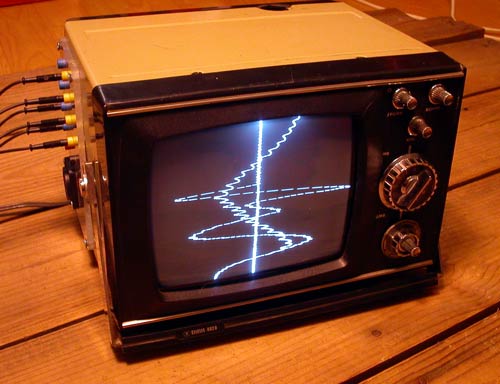
Pulse TV Sure, this will seriously void the warranty on your TV but that’s what surplus store are for. The mod is pretty straight forward, you are feeding audio signals directly into the deflection inputs on the cathode ray tube of the set. This will cause the electron beam to paint not a regular image but something more along the lines of what you would get from an oscilloscope. I have a 5" Bentley portable TV that is just about to go under the knife for this mod. If all works well I should have some video of the results pretty soon.

electro-music.com :: View topic – using TV to display audio signals

BOINC – Grid Computing in Your Off Hours

BOINC

BOINC, or ‘ Berkeley Open Infrastructure for Network Computing’ is the  just the thing if your into getting the most out of your extra CPU cycles. Years ago this idea made headlines when SETI@home was started and you could download a program that would sift through the volumes of data that was collected by radio astronomers in the hopes that a sign of life could be found off our own planet. The software has evolved into a common set of tools that can be used to churn out results for everything from climate change to computer animation. For a full list of projects you can take part in go here and of course you will need the base software and thats avaliable when you follow the link:
BOINC

Otona No Kagaku Stirling Engine Kit

 Otona No Kagaku-Stirling engine-021

Otona No Kagaku, or ‘Science for Adults’ is a ‘mook‘ (‘M’agazine + b’OOK’) series published by Gakken in Japan. Each issue has includes a kit that goes along with whatever the issues topic is. This one deals with heat engines and comes with a low temperature Stirling engine. The entire project took me about an hour to put together and it quite satisfying once you see it chugging away over a cup of hot water. This kit was bought from Karakuricorner, they have loads of the mooks there. If you know of anyone that likes science and can use a screw driver I would seriously think of buying one of these at a gift. And it’s not like the projects are lame either, you can make a pinhole camera, radio receivers from crystal to vacuum tube, microscopes, telescopes, and even a planetarium. I can only hope that one day I’ll be able to go into a book store of hobby shop here in the US and find kits of this quality and diversity. There may be some hope in this as I did notice that the pages of the mook are numbered from left to right. This would make translating the layout into English a lot simpler.

Translated version of the Otona no Kagaku web site 

Stirling engine kit photoset on Flickr

(Otona no Kagaku group on Flickr)

Stirling engine video