 I saw this a few days ago on Boing Boing. After seeing how under certain circumstances ice crystals in the air can reflect lights on the ground It’s easy to see how these could be mistaken for UFOs.
Category: Science
BOINC – Grid Computing in Your Off Hours

BOINC, or ‘ Berkeley Open Infrastructure for Network Computing’ is the just the thing if your into getting the most out of your extra CPU cycles. Years ago this idea made headlines when SETI@home was started and you could download a program that would sift through the volumes of data that was collected by radio astronomers in the hopes that a sign of life could be found off our own planet. The software has evolved into a common set of tools that can be used to churn out results for everything from climate change to computer animation. For a full list of projects you can take part in go here and of course you will need the base software and thats avaliable when you follow the link:
BOINC
Otona No Kagaku Stirling Engine Kit

Otona No Kagaku, or ‘Science for Adults’ is a ‘mook‘ (‘M’agazine + b’OOK’) series published by Gakken in Japan. Each issue has includes a kit that goes along with whatever the issues topic is. This one deals with heat engines and comes with a low temperature Stirling engine. The entire project took me about an hour to put together and it quite satisfying once you see it chugging away over a cup of hot water. This kit was bought from Karakuricorner, they have loads of the mooks there. If you know of anyone that likes science and can use a screw driver I would seriously think of buying one of these at a gift. And it’s not like the projects are lame either, you can make a pinhole camera, radio receivers from crystal to vacuum tube, microscopes, telescopes, and even a planetarium. I can only hope that one day I’ll be able to go into a book store of hobby shop here in the US and find kits of this quality and diversity. There may be some hope in this as I did notice that the pages of the mook are numbered from left to right. This would make translating the layout into English a lot simpler.
Translated version of the Otona no Kagaku web site
Stirling engine kit photoset on Flickr
(Otona no Kagaku group on Flickr)

The Cathode Ray Tube site

I know these aren’t the homemade variety but they are still fantastic.
Homemade Cathode Ray Tubes

First the Sparkmuseum post and now this. What a fantastic month for mad scientists this has been! This has got to be the coolest home brew page I have seen in years.
This guy makes cathode ray tubes from scratch! This has officially buried the needle on my clever meter. Using phosphor from common florescent tubes he coats the inside of a glass tube and evacuates the air. When an electron beam exits a small hole in the discharge tube that is mounted inside the phosphor glows. He has even added deflection coils (magnets) to create an oscilloscope! You can see some videos here, here, and here.
His other projects include a photo cell made from salt water and copper , a rectifier made from borax, and even a Homemade Tunnel Diode and RF Oscillator. He also has built his own vacuum tubes. Talk about hardcore!
The Sparkmuseum
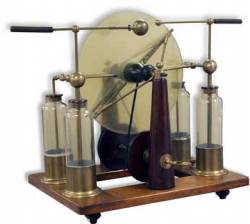
Here are some fantastic examples of equipment from the heady days of electrical experimentation, lots of beautiful photos of static devices, crystal radios, and vacuum tubes. For the past 35 plus years John Jenkins has been collecting various examples of early wireless sets, electrostatic devices, books and just about anything else related to the discovery of electricity. Much of his collection can be seen in the American Museum of Radio and Electricity in Bellingham Washingtion.
I’ve been fascinated by antique electrical aparatus like leyden jars and electrophorus. And sites such as these can give valuable tips on how these devices were created. With all the digital cameras, smart cards, and wifi communications its nice to be able to look back on a time where things were simpler and new discoveries were frequent.