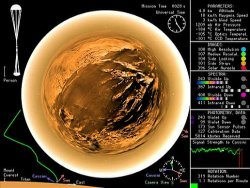
Titan Descent Data Movie

Titan Movie 

This is like a performance art piece from space. The decent of the Huygens probe on to the surface of the moon Titan took almost four hours but this video compresses it into 5 minutes. The visuals give you information on what the cameras were seeing, how the parachute moved (handy for telling wind conditions), and what sensors were doing what.

[via boing boing

NASA – Titan Descent Data Movie with Bells and Whistles – Movie

2006 Makefaire

MakeFaire 2006

 
The 2006 Makefaire is going on in San Francisco Ca this weekend. If your in the area or have enough cash burning a hole in your pocket to get a flight there you should go. Hobbyists, scientists, tinkers, gadget makers, Mythbusters, warrenty voiders, and a slug of other cool people are there discussing what they do and showing you how to do it. If your like me and are stuck at home, you can catch some video and see photos of it online.

No Ice Please

De-Iceing Coating

This is pretty neat stuff, the thing that makes it even neater is that it uses the same principal that keeps a gecko lizard stuck to walls. 

Dartmouth College engineering professor Victor Petrenko… has devised a way to use a burst of electricity to remove ice caked on walls or windows. For surfaces coated with a special film, the jolt gets rid of ice in less than a second, far less time than it takes to hack at it with an ice scraper.

Look for this soon on everything from car windows to the wings of airplanes. 

A high-tech way to defrost

Spiffy Sci-fi Glasses With Auto Focus


Hum, glasses with LCD ‘lenses’ in them that will auto focus and thus eliminate the need for bi-focals. This is so cool because I’m sure that in a few years I’m going to need them. I wonder if when they hit the street they will be featured in a movie. You know, one of those product placement deals where the item gets some serious closeups when the protagonist has pensive moments.

"…The dynamic glasses change focus using a 5-micron-thick layer of nematic liquid crystal, sandwiched between two pieces of glass. Molecules of the liquid crystal reorient themselves when exposed to an electric field and the researchers used this to create a type of dynamic Fresnel lens.

In a normal Fresnel lens, concentric rings are carved into a piece of glass causing light to become focused in a similar way to a conventional lens. Dynamic glasses mimic the Fresnel effect using concentric circles of clear electrodes on the pieces of glass containing the crystal. Activating these electrodes causes the liquid crystal to align into rings and focus light passing through the lens…"

Smart glasses switch focus in an instant