 Just how far away are planets, stars and nebula to our planet? Very handy for planning your next vacation.
[via digg]
universe5py.gif (GIF Image, 1278×8425 pixels)
Alt location
Eclectic junk from the four corners of the ‘Net. And pictures too!
Just how far away are planets, stars and nebula to our planet? Very handy for planning your next vacation.
[via digg]
universe5py.gif (GIF Image, 1278×8425 pixels)
Alt location
Wow, some impressive footage from a camera bolted to the side of one of the boosters on the latest space shuttle mission. You know, I bet you could sell rides on this.
From launch to a water landing, this stunning video shows you exactly what it would be like if you were duct tapped to the side of a space shuttle solid rocket booster. They get extra points from me for adding sound to the video. They must have bolted a transducer to the space frame of the SRB. RocketCam has more videos from past SST missions and even a few from some satellite launches.
[via neatorama]

It’s the spot in the center. For an idea of the size of the lander take a look at this photo of Carl Sagan posing next to a one to one scale model of a Viking lander. The two bright points on either end must be the wind covers over the RTG and propellant tanks.
NASA’s Viking Lander 2 landed on Mars on Sept. 3, 1976, in Utopia Planitia. The lander, which has a diameter of about 3 meters (10 feet), has been precisely located in this image from the High Resolution Imaging Science Experiment on NASA’s Mars Reconnaissance Orbiter. Also, likely locations have been found for the heat shield and back shell. The lander location has been confirmed by overlaying the lander-derived topographic contours on the high-resolution camera’s image, which provides an excellent match.
The camera on the probe is amazing, it was even able to capture pictures of Opportunity and Spirit as they were hanging out on the surface. I wonder if NASA will image the area where the Mars Polar Lander was lost so see what might be there.
[via New Scientist]
Viking Lander 1 (Thomas A. Mutch Memorial Station) Imaged from Orbit
Viking Lander 2 (Gerald A. Soffen Memorial Station) Imaged from Orbit

Back when the former Soviet Union was still shelling out the mega bucks in the space race someone decided that they needed a space plane. I guess they read and believed all the hype and press that the US shuttle program had gotten back in the Nixon years. Two week turn around times, $50US per pound as a payload cost, on budget… Yeah, if everything would have worked out things up there would be pretty sweet. Anyway, The Soviets ‘found’ some plans and built there own. By 1988 they were flight testing the crafts. The Russian shuttles were never launched with a crew, for it’s space testing everything was done by remote. That’s something that the Russians have mastered, running entire space missions 100% from the ground (I’m not counting space probes, those aren’t man rated vehicles). By 1993 the Buran program was cancelled and they fleet of five space shuttles were either dismantled or sold. The one in these pictures could be of Buran Ptichka or ‘little bird’, if they are somewhat current. Wikipedia says that it’s in the MIK building at the Baikonur Cosmodrome in Kazakhstan. It’s sad to see such a fine example of space hardware just sitting out in the open like that.
[via English Russia]
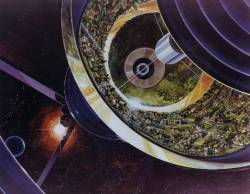 Way back in the 70’s NASA commissioned a few studies on what long term space colonies might be like. Many artistic renderings were done as visual aids and have become icons of a future that might have been. I remember seeing these on the pages of Starlog
The educational resources are simply a joy to browse through. I mean, where else are you going to find data on low-g agriculture and a Ringworld simulator?
[via MAKE, boingboing]
Space Settlement Education Information
