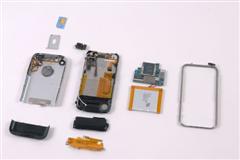
Well the elusive iPhone has been captured, dissected and photographed and is now ready to be stuffed and mounted. Somewhere in the night time sky a star has gone out.
The hipster hacker friendly micro platform known at the Chumby should be relaesed upon the public soon. Any day now. Maybe tomorrow. Maybe. I don’t code but I’d be willing to learn if I had one of these.
David Pouge, New York Times technology writer, gives a brief overview of the pros and cons of the upcoming uber phone from Apple. This a quick run down of what he said: Pros: Interface is slick, it’s an iPod, screen is great, feature integration is fantastic, WiFi, Apple logo Cons: No memory slot, can’t replace the battery yourself, service through AT&T only, EDGE data speeds suck.
Quite amazing. I hope he builds some more computer parts out of wood.
… a few months ago, I had an idea as to how the divide by two mechanisms from my first marble machine could be cascaded together to actually function as a sort of adder or counter. Once I had that idea, I knew I had to try it at some point, and recently, I finally got around to building my marble binary adding machine.
This is a solid-state Tesla coil. The primary runs at its resonant frequency in the 41 KHz range, and is modulated from the control unit in order to generate the tones you hear. So just to explain a little further, yes, it is the actual high voltage sparks that are making the noise. Every cycle of the music is a burst of sparks at 41 KHz, triggered by digital circuitry at the end of a "long" piece of fiber optics.
I personally think that this should be standard fare in a marching band. Just think of it for a second, it’s perfect. Loud enough to be heard over the roar of the crowd, easy to play (keyboard interface?), and it includes it’s own light show! Sure, it might take twenty people to haul the batteries around behind it but that is a small price to pay for something as spectacular as this. And just think of it in a battle of the bands. Put one of these on the point of your formation and the competition will drop like flies. You might need to insulate the musicians that have to march near it but that would sort itself out I would think.
If you ever find yourself with a pile of wire and big transformers and can work with tools without killing yourself you might want to build a Tesla coil. What a Tesla coil does is transform low voltage low frequency (120V / 60 Hz) power into high voltage high frequency (5-1000 KV / 10-2000 KHz) power. It’s done by finely tuned coils and capacitors that resonate at the greatest efficiency. The results can be quite spectacular. The image I used for this entry is of a Tesla coil I shot a few years ago. It was pounding out a million volts of electricity and producing a dazzling display of sparks. The coil was about three feet high and the breeze made by the charge was downright amazing. The guys at Deep Fried Neon have all the info that you will need to get started in the wonderful hobby.
 Well the elusive iPhone has been captured, dissected and photographed and is now ready to be stuffed and mounted. Somewhere in the night time sky a star has gone out.

