Now I can see why the British call them ‘torches’! A modded MagLite, some high power batteries and a projector bulb will get you one hell of a hot flashlight. WARNING! Do not use this to read books under the covers, that is unless you sleep on a stone slab and your sheets are made of asbestos.
Extreme Geek – Fire starting flashlight
Category: Technology
DIY Nikon D70 Infra-red Remote Control
 This is just the thing you need to have in your camera bag. I have one that I bought online but if your not in a rush and have the skills to solder this would be a clever little device to have around. Very handy for tripping the shutter when your doing macro work or your doing long exposures where camera vibration is a bad thing.
This is a replacement for the sparsely available Nikon ML-L1 and ML-L3 IR remote controls. Like the original remotes, this very simple circuit allows you to remotely release the D70 shutter or do a bulb exposure while avoiding camera shake. It should also work with other Nikon (d)SLR’s, provided they are supported by the ML-L1 or ML-L3. The IR sensor of the D70 is behind the round black plastic spot above the D70 logo on the body.
DIY Analog Video Synth
 Who says that you can only circuit bend audio devices?
Video synthesis tends to be dominated by digital technology these days however analogue video synthesis techniques can still offer a great many advantages in terms of aesthetics, performance, simplicity, and adaptability. Not to mention the non-linear surprises which can come from working in the analogue domain. This "VGA Expropriator" will be the first in a series of proprietary analogue hardware devices which seek to explore the possibilities of digital/analogue hybrid technology in video/audio performance and studio production contexts. The first offering here is essentially a new design with its creative process making ample use of circuit-bending methodologies.
[via Retro Thing]
Sensorama: Virtual Reality from 1962
 Who says that virtual reality is anything new? Inventor and cinematographer Morton Heilig had a firm grip on it back on the early 60’s:
(Sensorama was) an immersive 3-D virtual reality motorbike ride, in a form factor resembling an arcade game. Heilig saw Sensorama as the future of cinema, an immersive experience, complete with nine different fans to simulate the wind blowing on the user’s face, vibrating seat (to simulate driving over cobblestones), and the aromas of jasmine and hibiscus as the driver passed a flower garden, or the smell of baking pizza as one passed by an Italian restaurant in Brooklyn. (Rheingold, 1991) It never received the funding necessary to scale up to commercial production, and quietly disappeared, although Heilig persisted, patenting improvements over the next decade.
[viaNeatorama]
DIY Wet Cell Battery
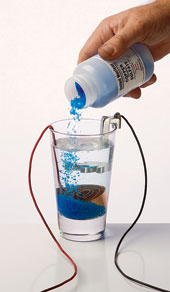 Nice project, and best of all pretty safe.
One particularly photogenic type of battery was known as a “gravity cell,” because gravity is what held it together. Typically used to power telephone and telegraph circuits, it consisted of a solution of blue vitriol (known these days as copper sulfate and sold in garden centers for pond treatment) on the bottom and a layer of zinc sulfate on top, kept separate only by their slightly different densities.
At the top, the electrode gives off zinc ions, while at the bottom, copper sulfate is reduced into copper metal. Together these complementary reactions produce just over one volt; string five batteries in series, and you get enough power to run a flashlight or charge an iPod. Any movement disturbs the delicate layers, ruining the battery, but if you’re careful, you can drop in new crystals of blue vitriol as needed, and the battery will run for years.
Copper sulfate is fun to play with by the way. If it’s heated to drive out moisture and left to cool you get a nice exothermic reaction when you add a drop of water to the pile of powder. Your not going to heat a meal but it does produce a little steam.
[via MAKE]
Popular Science Gray Matter – Build your own battery
Ultra-Dense Optical Storage — on One Photon
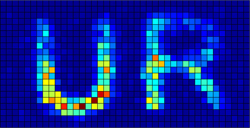 This could make all of our current storage mediums of today look as advanced as knotted strings in a few years.
“It sort of sounds impossible, but instead of storing just ones and zeros, we’re storing an entire image,” says John Howell, associate professor of physics and leader of the team that created the device, which is revealed in today’s online issue of the journal Physical Review Letters. “It’s analogous to the difference between snapping a picture with a single pixel and doing it with a camera—this is like a 6-megapixel camera.”
Sounds a bit like a holographic process:
To produce the UR image, Howell simply shone a beam of light through a stencil with the U and R etched out. Anyone who has made shadow puppets knows how this works, but Howell turned down the light so much that a single photon was all that passed through the stencil. Quantum mechanics dictates some strange things at that scale, so that bit of light could be thought of as both a particle and a wave. As a wave, it passed through all parts of the stencil at once, carrying the "shadow" of the UR with it.
My biggest question is how will you back up all of your data, assuming that this is used for anything but short term buffers.