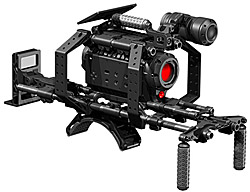
 A friend in the video business told me about this camera system. First thing you have to remember is that many professional video cameras are much like professional or prosumer still cameras. You can change the lenses and sometimes the part the hold the film. With a video camera you can swap lenses and many times the part the records the video that your shooting. It’s a handy feature when your client asks for everything to be shot on DigiBeta and not DVPro.
The Red Digital Cinema system takes this modular design to an extreme. Built around a core image sensor unit, the Red system uses an amazingly huge sensor to capture the scene. Weighing in at 12 mega pixels, the Mysterium CMOS sensor is 24.4 x 13.7mm in size. This baby will have no issues with loss of detail or depth of field issues that plague cameras with smaller sensors. Each frame is captured at 4520 X 2540, 1-120 fps, progressive HDTV format (4.5k (2540P), 4k, 2k, 1080P, 720P or 480P) in a 4:4:4 color space. Yeah, that’s bigger than what my Nikon D70 (3006×2000) captures! There is a sample image here if you want to see just how crisp the picture is. To put the image size and quality into a little perspective for you think of those little 110 format cameras that were popular in the ’70. The negative was about the size of your thumb nail. That’s what a standard DV camera will capture. Now the Red system would have to be a medium format negative, like the kind that’s popular with professional photographers. Many many times larger. You can see a good example here.
So you have a knock out image capture system but what about the other parts of the camera? Ahh, now there is another chunk of high tech coolness. It’s all built on a modular system called the Red-Rail. Bolt on whatever parts you need for the job. Shooting ENG, bolt the hand grips and shoulder pad to it. Studio shooting, tripod mount and a larger external LCD display. You get the idea.
The camera has FireWire 800/400, USB-2 and e-SATA interfaces so output isn’t an issue at all. Heck, it will even use up to a 128GB flash drive. Once you footage is on the drives you can pretty much do with it whatever you want. The workflow options will cover just about everything you might ever need to shoot. Shoot, process, correct, re-size, encode, edit.
I can’t wait to see video shot with this system. At a price of $17,500US it might sound too expensive but that’s very reasonable for professional video gear.
Full tech specs here.
RED Digital Cinema
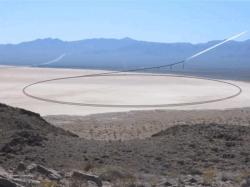 This so reminds me to the high altitude research project that was dreamt up by Gerald Bull. Bull had this idea that he could build the gigantic gun that would shoot satellites into space like something out of a Jules Vern book. He came close, he was able to loft a 330 pound round about 60 miles off the Earth. He was assassinated in 1990 after making some rather poor choices in the countries that he dealt with. Ah, he would have loved this concept. LaunchPoint Technologies has this idea would utilize a 1-1/4 mile superconducting ring to, over the course of several hours, accelerate a sled with a 22lb payload to a speed of 5 miles a second. The payload would then separate from the sled and be ‘fired’ through a tunnel that is angled 30 degrees up. The projectile would be moving at over 23 times the speed of sound at this point and the next stop would be low Earth orbit. The payload would only have to survive around 2000G but it’s pointed out that laser guided artillery rounds routinely survive forces of over 20,000G. So far it’s just a theoretical design but if it works it could bring the cost per pound to launch hardware into space down to Earth.
 What would you say if someone told you that they are going to fly their model plane into a hurricane? Crazy right? That’s exactly what you would think but the bright lads over at the