Fossett Sets Glider Record

Fossett sets glider record Wearing NASA spacesuits and flying along the crest of the Andes, pilot Steve Fossett and co-pilot Einar Enevoldson took their ‘Perlan’ high performance research glider on the world’s first stratrospheric glider flight yesterday – surfing the Andean ‘mountain wave’ to a height of 50,699 feet (15,453 m) – while breaking the previous record by 1,662 ft (507m)


That’s an astounding record to have broken, most comercial airliners cruse in around 33,000 feet and they have thrust. The glider had but the heat from the ground to give it energy to make it up so high. In fact…

During the course of the flight (primarily within a 60 mile radius of El Calafate near the border of Argentina and Chile), the American pair found themselves flying well above commercial air traffic – a fact received with bemusement by pilots of passenger jets under the same air traffic control. Steve Fossett recalled: “I couldn’t understand the Chilean controller describing us in Spanish to the airline pilot – but I understood the answer by the pilot: ‘Wow’.”

Wow is right! If you were asked to choose a role model Steve Fossett would be a good choice. For more info on this amazing man take a look at his write up on Wikipedia.

[via Flight Nest]

New world glider altitude record set by Fossett and Enevoldson in Argentina

Cryptochromes and Blue Light Give Birds and Plants a Magnetic Sense

Chirp, I say chirp damm it!

 If it were not for the fact that you would have to be born with these or at least have replacement eyes with these molecules in them, this would be very cool. I wonder what it would look like? Maybe a slight glow to the north, or maybe it would be like looking at the sky through polarized glasses.

Some birds, notably migratory species, are able to detect the Earth’s magnetic field and use it to navigate. New results from a team of Franco-German researchers suggest that light-sensitive molecules called cryptochromes could be the key to the birds’ magnetic sense.

[via slashdot

Scientists discover molecule behind birds’ magnetic sense

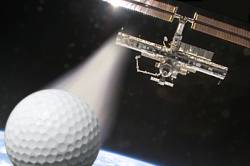
Russian Cosmonaut to Whack Golf Ball From ISS

FORE!

Well these things don’t fly for free. I wonder if NASA will ever fully embrac the capitalistic opportunities of space. Spin-off projects are great, everyone loves CAT scanners, micro electronics, and Tang but there are so many other uses for space. Advertising is just one of the uses that the Russian space agency has employed so far. In the future once a larger habitation structure can be built the possibilities for generating revenue for space agencies broaden significantly.

A Russian cosmonaut will whack a golf ball from the international space station in a publicity stunt on Thanksgiving Day, NASA officials said Tuesday, Associated press news agency reports.
Russian flight engineer Mikhail Tyurin will show off his swing to promote a Canadian golf club manufacturer during a spacewalk on Nov. 23.

Russian Cosmonaut to Whack Golf Ball From ISS

Orbiter – A free space flight simulator

Orbiter I like a game that tells you to crack open the books so you can understand enough to play.
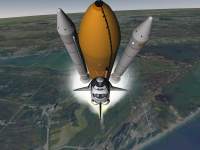
ORBITER is a free flight simulator that goes beyond the confines of Earth’s atmosphere. Launch the Space Shuttle from Kennedy Space Center to deploy a satellite, rendezvous with the International Space Station or take the futuristic Delta-glider for a tour through the solar system – the choice is yours. But make no mistake – ORBITER is not a space shooter. The emphasis is firmly on realism, and the learning curve can be steep. Be prepared to invest some time and effort to brush up on your orbital mechanics background.

Orbiter – A free space flight simulator

Voyager 1 – 100 AU Out and Still Going

Voyager The guys could build them pretty good back they couldn’t they? 30 years and it can still send back science data.

Voyager 1, already the most distant human-made object in the cosmos, reaches 100 astronomical units from the sun on Tuesday, August 15 at 5:13 p.m. Eastern time (2:13 p.m. Pacific time). That means the spacecraft, which launched nearly three decades ago, will be 100 times more distant from the sun than Earth is.

JPL.NASA.GOV: Feature Stories