Another amazing science kit from Gakken! This time it features artist Theo Jansen, a world renowned kinetic sculptor that hopes to one day let his creations roam free on the wind swept beaches of the Netherlands. This kit looks amazing, not too unusual for a Gakken kit, and pretty easy to assemble. Like all of the projects in this Mook series, the instructions will be all in Japanese but drawn so well that you don’t need to read any of the text to understand it. The project takes you through building a beautiful wind powered walking creature that is as graceful as it is complex. I can’t wait to get my hands on one of these!
[via MAKE Flickr pool] cloud9science @Wiki – テオ・ヤンセンのミニ・ビーストを作ってみた
I have a pool of photos on Flickr that contains images of some kits and photos taken by some of the cameras that have been featured in the series. Have a look and if you have been graced by owning one of these inspiring products consider contributing a picture or two to the pool.
I’ve long been a fan of the HDR image. Shooting full motion video has never seemed to be an option until now:
Anyone who regularly uses a video camera will know that the devices do not see the world the way we do. The human visual system can perceive a scene that contains both bright highlights and dark shadows, yet is able to process that information in such a way that it can simultaneously expose for both lighting extremes – up to a point, at least. Video cameras, however, have just one f-stop to work with at any one time, and so must make compromises. Now, however, researchers from the UK’s University of Warwick claim to have the solution to such problems, in the form of the world’s first full High Dynamic Range (HDR) video system.
The PrimoGraf is a hand cranked drawing machine. Using wooden gears with prime number based gears an infinite array of drawings can be made. It comes complete with 7 gears, 2 set of rods and penholders so you can create many variations. Different setups can be achieved instantly by simply picking different holes.
Made of walnut, basswood, and solid brass and hand crafted in Portland, Oregon.
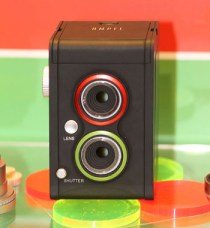
A clever concept camera that combines retro instant pictures with even more retro pinhole photography. Each camera comes pre-loaded with two sheets of Fuji Film instant film (probably Instax mini ) and easy to follow pictograms on the back. You pop open the camera, open the shutter flap to make the exposure, and then collapse the camera again. The pencil that’s included is then rubbed along the back in one direction to burst the developing paste on the film. Cut in half and you have two photos, one for you and one to send as a post card to a friend. Very clever! I now have a reason to get a pack of that film and mess around with it.
Researchers have discovered that a species of hornet might be able to convert sunlight directly into energy via pigments in it’s exoskeleton…
Ishay found that shining light on the hornets—live, anesthetized or even dead—could produce voltage differences of several hundred millivolts across their hard exoskeletons, which suggested that the cuticle material making up the exoskeletons was effectively an organic semiconductor converting light into electricity. Indeed, Ishay even found that shining ultraviolet light on an anesthetized hornet would wake it up faster, as though the light were recharging the insect.
If this proved to be an accurate assessment of the insects abilities it might be possible to ‘grow’ photovoltaic cells.
(Thanks to special field researcher Greg for this link)
VANDENBERG AIR FORCE BASE, Calif. – The U.S. Air Force’s first
unmanned re-entry spacecraft landed at Vandenberg Air Force Base at
1:16 a.m. PST today.
The X-37B, named Orbital Test Vehicle 1 (OTV-1), conducted on-orbit
experiments for more than 220 days during its maiden voyage. It fired
its orbital maneuver engine in low-earth orbit to perform an
autonomous reentry before landing.
The X-37B is the newest and most advanced re-entry spacecraft. Managed
by the Air Force Rapid Capabilities Office (AFRCO), the X-37B program
performs risk reduction, experimentation and concept of operations
development for reusable space vehicle technologies.
“Today’s landing culminates a successful mission based on close
teamwork between the 30th Space Wing, Boeing and the Air Force Rapid
Capabilities Office,” said Lt Col Troy Giese, X-37B program manager
from the AFRCO. “We are very pleased that the program completed all
the on-orbit objectives for the first mission.”
OTV-1′s de-orbit and landing mark the transition from the on-orbit
demonstration phase to a refurbishment phase for the program.
The Air Force is preparing to launch the next X-37B, OTV-2, in Spring
2011 aboard an Atlas V booster.
I wonder if the X-37B has enough delta V to make it to the ISS? If it did then there might be hope for more re-supply missions that don’t rely on the Russian Progress launches.