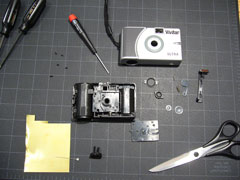
Take one cheap fixed focus single shutter speed camera and some thin brass and you too can build a pinhole camera. He has a nice bit on how to accurately measure the pinhole to deduce the aperture so you can make good exposures.
Eclectic junk from the four corners of the ‘Net. And pictures too!
Take one cheap fixed focus single shutter speed camera and some thin brass and you too can build a pinhole camera. He has a nice bit on how to accurately measure the pinhole to deduce the aperture so you can make good exposures.
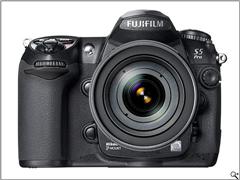 Mumm… This may make me re-think my choice of Nikon as my main camera. I love the idea that the image sensor (CCD) is split between normal imaging units and ones that are set to capture a broader range of light. This gets the medium of digital photography closer to the tonal range that chemical photography has. If your lost, this means that if your taking pictures at the beach on a sunny day you will have a better chance of getting details in the shadows then you normally would. I have some examples of high dynamic range images here if you want to take of look. The camera won’t take photos like these but you can see what you get when you have more data across the full range of light values in a photo.
Fujifilm has today announced the Fujifilm FinePix S5 Pro, or at least the development of it, due to be available in ‘early 2007’. The S5 Pro features the same SuperCCD SR design sensor although now called ‘SR Pro’, it features 6.17 million ‘S photodiodes’ (normal DR) and 6.17 million ‘R photodiodes’ (highlight DR) for a total photodiode count of 12.34 million.
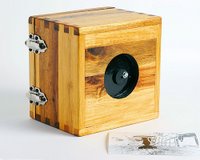 I love this, I had the same idea a while back but just haven’t finished the project.
Homemade 5×4 pinhole camera. Made from an Ikea plant pot. holder. The pinhole is made from a Coke can, the shutter is a tap washer. All the finihing materials found around the house. Also shown is the first 5×4 paper neg I made during the camera’s construction.
The camera’s aperture is f-256 so the images are pretty crisp and a film holder has been added to the design. Very cool what you can do with a bit of creative spirit.
[via ikea hacker]

Recently, the space probe Cassini sent back a mess (over 160) images taken with it’s wide field camera that were assembled into this breath taking image of our solar systems premiere ringed planet Saturn. The color enhanced image (shown here) shows not only the rings we are used to seeing but others that are too faint to be seen normally.
[via boingboing]

In the ever popular search for cool gear for your gear I saw this. It says that by sticking this special screen over your personal media player and bam! You get eye popping 3d media. Well… Hold on there. i know a little bit about autostereo displays. I’m going to take a stab in the dark and make a guess how this works. First you are going to need some content in 3D. Left and right images or clips of video taken with a 3d camera. That’s a no brainer. Second, the content will have to go through a special media player that will either interlace the left and right feeds on the fly or will play back stuff that you have converted on your PC. It more than likely has more horsepower than a PMP. What you will get when you look at the PMP with out the special screen will be a sliced up picture that has striped of content side by side. Maybe a few pixels wide. The screen is a lenticular lens array that will shift the slices of image to it’s respective eye. A good example of all this is an article on DIY lenticular prints that I wrote up a few days ago. I’ve seen professional systems that have these, nice 36" LCD screens, and the images look pretty good. Or it will use a red/green color image anaglyph. Those look ok in my opinion. I’ve never seen a color anaglyph that looks 100 percent real. I’m hoping for a true stereo image but you can never tell.
I’m looking forward to seeing one of these sceens in place one day. I have a crap load of stereo images and I’d love to show them to people from my PDA.
[via ubergizmo]
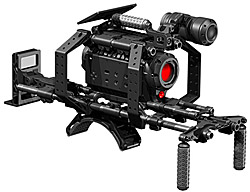 A friend in the video business told me about this camera system. First thing you have to remember is that many professional video cameras are much like professional or prosumer still cameras. You can change the lenses and sometimes the part the hold the film. With a video camera you can swap lenses and many times the part the records the video that your shooting. It’s a handy feature when your client asks for everything to be shot on DigiBeta and not DVPro.
The Red Digital Cinema system takes this modular design to an extreme. Built around a core image sensor unit, the Red system uses an amazingly huge sensor to capture the scene. Weighing in at 12 mega pixels, the Mysterium CMOS sensor is 24.4 x 13.7mm in size. This baby will have no issues with loss of detail or depth of field issues that plague cameras with smaller sensors. Each frame is captured at 4520 X 2540, 1-120 fps, progressive HDTV format (4.5k (2540P), 4k, 2k, 1080P, 720P or 480P) in a 4:4:4 color space. Yeah, that’s bigger than what my Nikon D70 (3006×2000) captures! There is a sample image here if you want to see just how crisp the picture is. To put the image size and quality into a little perspective for you think of those little 110 format cameras that were popular in the ’70. The negative was about the size of your thumb nail. That’s what a standard DV camera will capture. Now the Red system would have to be a medium format negative, like the kind that’s popular with professional photographers. Many many times larger. You can see a good example here.
So you have a knock out image capture system but what about the other parts of the camera? Ahh, now there is another chunk of high tech coolness. It’s all built on a modular system called the Red-Rail. Bolt on whatever parts you need for the job. Shooting ENG, bolt the hand grips and shoulder pad to it. Studio shooting, tripod mount and a larger external LCD display. You get the idea.
The camera has FireWire 800/400, USB-2 and e-SATA interfaces so output isn’t an issue at all. Heck, it will even use up to a 128GB flash drive. Once you footage is on the drives you can pretty much do with it whatever you want. The workflow options will cover just about everything you might ever need to shoot. Shoot, process, correct, re-size, encode, edit.
I can’t wait to see video shot with this system. At a price of $17,500US it might sound too expensive but that’s very reasonable for professional video gear.
Full tech specs here.