Basics of Space Flight From JPL

It’s one thing to say you like space stuff but it’s another to actually read up on how things in space work. Even a casual glance through this guide will answer a lot of common space questions. How do spacecraft talk to the ground? Why do things orbit stuff? Just what does a spacecraft do when it’s in the ‘cruse phase’? All of this stuff is in here and bunches more.

Basics of Space Flight

Our Sun in 3D

STEREO Sun

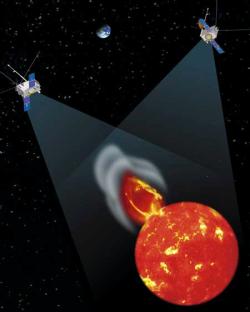
Another link sent to me by secret agent Greg a few days ago. Its a space mission to send two probes in an orbit around the sun that will enable us to see the surface of it in 3D. On Earth you can’t do this very well because you can only get so far apart and when your at that maximum distance you have a whole lot of distorting air between you and your object of observation. Once these satellites are in place it will allow CME (coronal mass ejections) and other particle emission events with depth. Why is this a good thing? Well it will give us a much better chance of preparing for the problems that often occur when the sun has a little ‘gas’ and we all get washed with extra radiation. That can cause communications blackouts, power failures in big cities, satellites to die. And if your living in space or just visiting (think airline crews) it can be a health hazard. I for one can’t wait until images from these guys start showing up on Astronomy Picture of the Day.
 

STEREO spacecraft to image solar blasts in glorious 3-D

Hayabusa Update


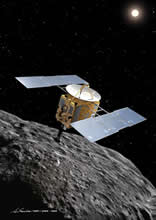
Looks as if there has been another setback in the mission of the little space probe that could, the craft has started to tumble and is not longer in a good position to receive communications from Earth. A small fuel leak caused it to spin in an unexpected way but the ground controllers have been able to calculate when it points in the right direction so communications could still continue. The new orientation still fulfils the com and power requirements but not by much. The overall mission has been extended  by a few more years in a hope that they will be able to recover and head back to home with the sample of asteroid Itokawa

Hayabusa project

Chameleon Scarf

LED Scarf 

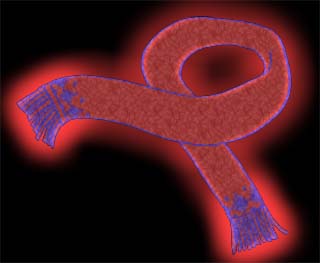
When my friend Greg sent me this link I’m sure he wasn’t thinking of the fashion applications of this new technology. The scarf uses a color sensor and a matrix of red, green, and blue LEDs to adopt the local color as it were. This reminds me of the active camouflage used by some ships and planes in WWII. The vehicle was illuminated by lights that were dimmed to match the ambient light levels. This would make the object harder to see at a distance. I suppose that the same would be true of a person wearing this if it was emulating the color of the wall behind the wearer. I doubt that it would be used in only this way, the fashion impaired would make a better market for this sort of thing.

Chameleon scarf coordinates with your outfit

The Cyberhand

Cyberhand

Amazing advancements are being made in the area of prosthetic limbs. I have always thought that if I were to lose a hand or a foot I’d want to enlist the aid of some of my friends that build robots to help come up with a mechanical solution to my dilemma. From what I’ve read about body replacements such as these its hard to do better than the old fashioned spring loaded claw/hook. I think that a real solution will only come when battery technology reaches the kilowatt per gram range, or a motor that uses picowatts of power yet still delivers foot pounds of torque are available.

These guys are getting there though. As you can see by the quoted article below, they have movement down:

Funded by the Future and Emerging Technologies initiative of the IST programme, the CYBERHAND project aims to hard wire this hand into the nervous system, allowing sensory feedback from the hand to reach the brain, and instructions to come from the brain to control the hand, at least in part…So far, the project is racking up an impressive list of achievements. It has a complete, fully sensitised five-fingered hand. The CYBERHAND prototype has 16 Degrees of Freedom (DoFs) made possible by the work of six tiny motors. Each of the five fingers is articulated and has one motor dedicated to its joint flexing for autonomous control. It features that miracle of evolution, the opposable thumb, so the device can perform different grasping action

 
They also have a working solution to the feedback needed to accuratly use a prosthetic hand. This is in the form of Thin Film Longitudinal IntraFascicular Electrodes. Lets hope that testing begins soon for this device, I’m sure that there are more than enough people who would be willing to test this for them. Next they should work on a prosthetic foot. It would have to be cheap enough to be given out by aid orginizations around the world.

[via Engadget and Slashdot ]

Cyberhand Project