Augmented Reality: Neon Racer

Neon Racer 

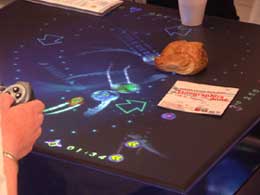
Yes, if you set your coffee mug down on the display you can halt the forward progress of your opponent. For added hazards small animals could also be used. I’m thinking that a small sleeping cat could be the perfect obstacle in this game. How long will the cat sleep? Will you be flying by it when it awakes and causes you to crash?

Neon Racer is a multi-user Augmented Reality (AR) racing game adapting the simple and powerful gameplay of racing games to an AR tabletop setting. The game combines an intuitive and tangible interface with quality content. In this demo we explore how a rich gaming experience can be created by using only a limited amount of virtual information. The game compacts the use of virtual elements to a minimum, displaying only the players’ racing vehicles and lap checkpoints. The active setting for the game is provided by the physical world, and all its parts can influence gameplay. Physical objects act as collision obstacles and influence the course of the race itself. Participants have to interact with both the virtual and real objects to succeed.

[via we-make-money-not-art]
Neon Racers 

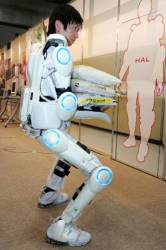
The HAL-5 is Online


As noted by me here a few months ago, the HAL bionic suit aims to enhance the strength of the person wearing it. It looks a bit better than the first version, more like something were accustomed to seeing in a Japanese cartoon (yeah, we all get the look of new technology from cartoons don’t we…) The info is a little sparse, but it does look cool.

The HAL-5 ready to battle

Ice Lens

Fire! 

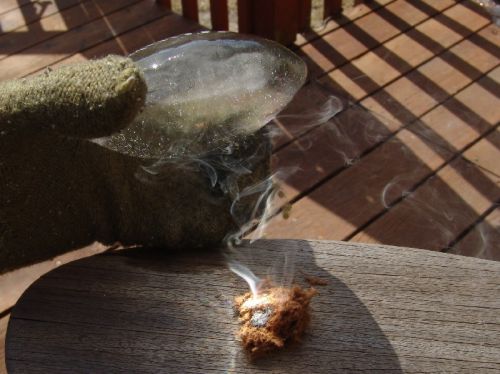
Take some water and let it freeze (without bubbles) and then carefully shape it into an ice lens in order to focus the suns energy on dry tinder to make fire. Good stuff to know if your out in the cold and need to make fire. Not that you would have a lot of time to do this if your only chance of lighting a fire was this method. I think you would freeze solid before you got the technique down. Perhaps this is the sort of thing that should be practiced before you need to use it. However, even as ice has a lower refraction index than glass with some time and practice you could build a simple refracting telescope out of this. A few ice lenses and some way of mounting them would be about all you would need. How cool would it be to be able to look at the magnified craters of the moon with an ice telescope?

Fire From Ice

The Cyberhand

Cyberhand

Amazing advancements are being made in the area of prosthetic limbs. I have always thought that if I were to lose a hand or a foot I’d want to enlist the aid of some of my friends that build robots to help come up with a mechanical solution to my dilemma. From what I’ve read about body replacements such as these its hard to do better than the old fashioned spring loaded claw/hook. I think that a real solution will only come when battery technology reaches the kilowatt per gram range, or a motor that uses picowatts of power yet still delivers foot pounds of torque are available.

These guys are getting there though. As you can see by the quoted article below, they have movement down:

Funded by the Future and Emerging Technologies initiative of the IST programme, the CYBERHAND project aims to hard wire this hand into the nervous system, allowing sensory feedback from the hand to reach the brain, and instructions to come from the brain to control the hand, at least in part…So far, the project is racking up an impressive list of achievements. It has a complete, fully sensitised five-fingered hand. The CYBERHAND prototype has 16 Degrees of Freedom (DoFs) made possible by the work of six tiny motors. Each of the five fingers is articulated and has one motor dedicated to its joint flexing for autonomous control. It features that miracle of evolution, the opposable thumb, so the device can perform different grasping action

 
They also have a working solution to the feedback needed to accuratly use a prosthetic hand. This is in the form of Thin Film Longitudinal IntraFascicular Electrodes. Lets hope that testing begins soon for this device, I’m sure that there are more than enough people who would be willing to test this for them. Next they should work on a prosthetic foot. It would have to be cheap enough to be given out by aid orginizations around the world.

[via Engadget and Slashdot ]

Cyberhand Project

Flexible Braille e-Paper


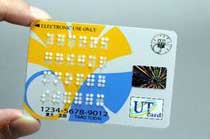
Researchers have come across a method for producing a flexible braille display that uses about the same power as a cell phone. The display can be refreshed in about one second and could be used to indicate the amount of money left on a prepaid card, household appliances, or even an e-book. It uses a plastic film with organic transistors and plastic actuators that expand when triggered. So far it will display 24 characters but researchers hope to take this up to 576 in a few years. Look for this to be on the market in five or six years.

[ via we-make-money-not-art]

Takao Someya Group–Organic Transistor Lab