Tag: Science
DIY Nitrogen Laser
 Everyone is talking about this today. I remember first read about a free nitrogen laser in the Scientific American Experimenters Handbook when I was a teenager. I was more into building a Van de Graff machine but I could still appreciate a laser that didn’t need any complex lasing fluids or expensive tubes or one of those ultra cool multi Joule flash lamps. Ahh.. Such day dreams those made up… Oh yeah, about the laser. Pretty much is uses a great whopping spark to excite the nitrogen atoms in the air to a higher state and in turn that liberates ultraviolet radiation. Cool, eh? Hubert’s page has all sorts of cracking info on how that darn thing works, the kid did his homework Looks like you could build one for less than $50 easy. The 10KV power supply could be obtained from a TV or you might even be able to get away with using one of those cheesy air ionizers you find in second hand shops. Or you could buy one from Information Unlimited. (Weird, I Googled ‘high voltage power supply’ and saw the link, I had no idea those guys were still around! Very cool!)
Hubert’s laser page: Air laser
And if that don’t do it for ya, check this one out you laser pervs! Home built nitrogen (N2) laser
Mard Recon Probe Spots Viking Landers

It’s the spot in the center. For an idea of the size of the lander take a look at this photo of Carl Sagan posing next to a one to one scale model of a Viking lander. The two bright points on either end must be the wind covers over the RTG and propellant tanks.
NASA’s Viking Lander 2 landed on Mars on Sept. 3, 1976, in Utopia Planitia. The lander, which has a diameter of about 3 meters (10 feet), has been precisely located in this image from the High Resolution Imaging Science Experiment on NASA’s Mars Reconnaissance Orbiter. Also, likely locations have been found for the heat shield and back shell. The lander location has been confirmed by overlaying the lander-derived topographic contours on the high-resolution camera’s image, which provides an excellent match.
The camera on the probe is amazing, it was even able to capture pictures of Opportunity and Spirit as they were hanging out on the surface. I wonder if NASA will image the area where the Mars Polar Lander was lost so see what might be there.
[via New Scientist]
Viking Lander 1 (Thomas A. Mutch Memorial Station) Imaged from Orbit
Viking Lander 2 (Gerald A. Soffen Memorial Station) Imaged from Orbit
Urban Light Pillars Above Cities
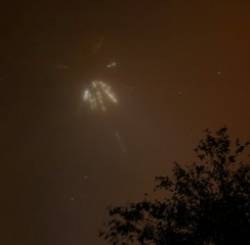 I saw this a few days ago on Boing Boing. After seeing how under certain circumstances ice crystals in the air can reflect lights on the ground It’s easy to see how these could be mistaken for UFOs.
BOINC – Grid Computing in Your Off Hours

BOINC, or ‘ Berkeley Open Infrastructure for Network Computing’ is the just the thing if your into getting the most out of your extra CPU cycles. Years ago this idea made headlines when SETI@home was started and you could download a program that would sift through the volumes of data that was collected by radio astronomers in the hopes that a sign of life could be found off our own planet. The software has evolved into a common set of tools that can be used to churn out results for everything from climate change to computer animation. For a full list of projects you can take part in go here and of course you will need the base software and thats avaliable when you follow the link:
BOINC
Otona No Kagaku Stirling Engine Kit

Otona No Kagaku, or ‘Science for Adults’ is a ‘mook‘ (‘M’agazine + b’OOK’) series published by Gakken in Japan. Each issue has includes a kit that goes along with whatever the issues topic is. This one deals with heat engines and comes with a low temperature Stirling engine. The entire project took me about an hour to put together and it quite satisfying once you see it chugging away over a cup of hot water. This kit was bought from Karakuricorner, they have loads of the mooks there. If you know of anyone that likes science and can use a screw driver I would seriously think of buying one of these at a gift. And it’s not like the projects are lame either, you can make a pinhole camera, radio receivers from crystal to vacuum tube, microscopes, telescopes, and even a planetarium. I can only hope that one day I’ll be able to go into a book store of hobby shop here in the US and find kits of this quality and diversity. There may be some hope in this as I did notice that the pages of the mook are numbered from left to right. This would make translating the layout into English a lot simpler.
Translated version of the Otona no Kagaku web site
Stirling engine kit photoset on Flickr
(Otona no Kagaku group on Flickr)
