
I know these aren’t the homemade variety but they are still fantastic.
Eclectic junk from the four corners of the ‘Net. And pictures too!
I know these aren’t the homemade variety but they are still fantastic.

First the Sparkmuseum post and now this. What a fantastic month for mad scientists this has been! This has got to be the coolest home brew page I have seen in years.
This guy makes cathode ray tubes from scratch! This has officially buried the needle on my clever meter. Using phosphor from common florescent tubes he coats the inside of a glass tube and evacuates the air. When an electron beam exits a small hole in the discharge tube that is mounted inside the phosphor glows. He has even added deflection coils (magnets) to create an oscilloscope! You can see some videos here, here, and here.
His other projects include a photo cell made from salt water and copper , a rectifier made from borax, and even a Homemade Tunnel Diode and RF Oscillator. He also has built his own vacuum tubes. Talk about hardcore!
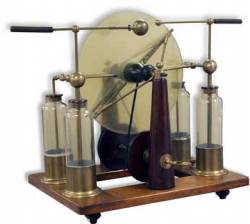
Here are some fantastic examples of equipment from the heady days of electrical experimentation, lots of beautiful photos of static devices, crystal radios, and vacuum tubes. For the past 35 plus years John Jenkins has been collecting various examples of early wireless sets, electrostatic devices, books and just about anything else related to the discovery of electricity. Much of his collection can be seen in the American Museum of Radio and Electricity in Bellingham Washingtion.
I’ve been fascinated by antique electrical aparatus like leyden jars and electrophorus. And sites such as these can give valuable tips on how these devices were created. With all the digital cameras, smart cards, and wifi communications its nice to be able to look back on a time where things were simpler and new discoveries were frequent.
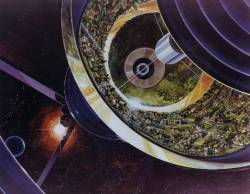 Way back in the 70’s NASA commissioned a few studies on what long term space colonies might be like. Many artistic renderings were done as visual aids and have become icons of a future that might have been. I remember seeing these on the pages of Starlog
The educational resources are simply a joy to browse through. I mean, where else are you going to find data on low-g agriculture and a Ringworld simulator?
[via MAKE, boingboing]
Space Settlement Education Information
 Come tomorrow, November 8th, many people (check the link for locations) will have the chance to see the inner most planet of our solar system make an attempt to eclipse the sun. This transit is a some what rare occurrence, as only about 13 will happen in the next 100 years. So grab your approved solar viewing gear and have at it!
SPACE.com — Viewer’s Guide: Watch Mercury Cross the Sun (warning, popups)
Wikipedia – Transit of Mercury
 This page fills my head with ideas! Steam engines, electrostatic generators, bi-metallic motors… Mumm.. Well if your not the tinkering kind of person then you should be happy to know that everything at Exergia is for sale. Yep, in kit form or a finished unit. So explore the wonders of science today! Or at lest by mid noon of next week. 🙂
A bit from the site:
Sophisticated demonstration models of alternative energy technologies for universities, schools and interested individuals: Stirling Engines and steam engines, fuel cells, photovoltaic objects, toys and more! Discover extraordinary ideas in energy related devices: Educational devices inspired by old and new concepts to demonstrate the physical principles of conventional and alternative energy conversion."
[via MAKE]