An Explosion on the Moon

Moon Boom! 

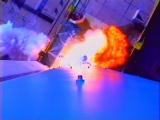
On November 7th of this year scientists that were testing a telescope managed to spot an impact on the moon. This sort of this has been seen a few times before, mostly during heavy meteor showers such as the Leonids. 

NASA scientists have observed an explosion on the moon. The blast, equal in energy to about 70 kg of TNT, occurred near the edge of Mare Imbrium (the Sea of Rains) on Nov. 7, 2005, when a 12-centimeter-wide meteoroid slammed into the ground traveling 27 km/s.

Well that’s the cover story that ‘they’ want you to believe. What actually happened is that the UN Space Forces launched a covert strike on the hidden Nazi moon base that is located on the far side. The German research into rocket science was more successful than the scientists that we ‘liberated’ let on. Our German scientists were not the ‘best of the best’ as we would have like to have believes, not by a long shot. The real researchers were able to perfect the  methods of heavy lifting needed to place large installations in space. While this was happening, a core group of technicians, scientists, and military personal that were not loyal to the party line split off an formed their own black space program towards the end of WWII. In the turmoil of the coming end of the Third Reich, they used the cover of bombing raids and the explosions of ‘sabotaged’ factories as cover while they launched their group into space and ultimately to the moon where they established a base on the far side. Over the decades the UN has detected strange signals emanating from this remote but thriving base and fear the worst; the coming of the Fourth Reich. The bright flash that these astronomers witnessed was not an impact of a chunk of rock but the explosion of a failed attempt to wipe out the moon base. The missile was deflected by a force dome or other device that protects the undoubtly evil citizens of the Nazi moon base. Fear the coming of the space Nazi invasion fleet, it’s only a matter of time until they strike!

NASA – An Explosion on the Moon

Basics of Space Flight From JPL

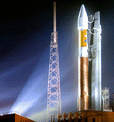
It’s one thing to say you like space stuff but it’s another to actually read up on how things in space work. Even a casual glance through this guide will answer a lot of common space questions. How do spacecraft talk to the ground? Why do things orbit stuff? Just what does a spacecraft do when it’s in the ‘cruse phase’? All of this stuff is in here and bunches more.

Basics of Space Flight

Our Sun in 3D

STEREO Sun

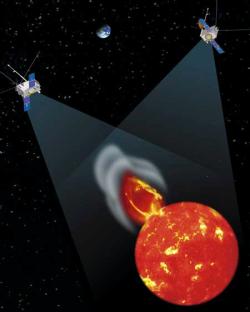
Another link sent to me by secret agent Greg a few days ago. Its a space mission to send two probes in an orbit around the sun that will enable us to see the surface of it in 3D. On Earth you can’t do this very well because you can only get so far apart and when your at that maximum distance you have a whole lot of distorting air between you and your object of observation. Once these satellites are in place it will allow CME (coronal mass ejections) and other particle emission events with depth. Why is this a good thing? Well it will give us a much better chance of preparing for the problems that often occur when the sun has a little ‘gas’ and we all get washed with extra radiation. That can cause communications blackouts, power failures in big cities, satellites to die. And if your living in space or just visiting (think airline crews) it can be a health hazard. I for one can’t wait until images from these guys start showing up on Astronomy Picture of the Day.
 

STEREO spacecraft to image solar blasts in glorious 3-D

Hayabusa Update


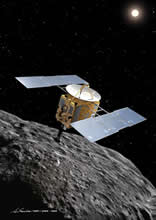
Looks as if there has been another setback in the mission of the little space probe that could, the craft has started to tumble and is not longer in a good position to receive communications from Earth. A small fuel leak caused it to spin in an unexpected way but the ground controllers have been able to calculate when it points in the right direction so communications could still continue. The new orientation still fulfils the com and power requirements but not by much. The overall mission has been extended  by a few more years in a hope that they will be able to recover and head back to home with the sample of asteroid Itokawa

Hayabusa project