A Meteoroid Hits the Moon

Moon impact 

Very neat. I hope that the next probe that is sent to map the surface will get some crist high detail images of this new crater.

There’s a new crater on the Moon. It’s about 14 meters wide, 3 meters deep and precisely one month, eleven days old. NASA astronomers watched it form: "On May 2, 2006, a meteoroid hit the Moon’s Sea of Clouds (Mare Nubium) with 17 billion joules of kinetic energy—that’s about the same as 4 tons of TNT," says Bill Cooke, the head of NASA’s Meteoroid Environment Office in Huntsville, AL. "The impact created a bright fireball which we video-recorded using a 10-inch telescope."

NASA – A Meteoroid Hits the Moon

Impressive Apollo Space Program Fan Site

A while back I ran across a page that has quite a bit of information on the Apollo space program. As fan sites go it’s amazing. You can even get a cool LEM screensaver from here. 

July 1969. Boosted aloft into the Florida skies by the immense Saturn V rocket, the Apollo 11 spacecraft carried men to the surface of a celestial body for the very first time. There have been many spacecraft built since the conclusion of the Apollo program, the Space Shuttle included. However, they merely creep above the atmosphere, flying only a scant few hundred kilometers above the Earth’s surface. To this day, Apollo remains the world’s first and only true spaceship. It journeyed farther, traveled faster and was more expensive than anything before or since

APOLLO MANIACS : Apollo spacecraft and Saturn Rocket / Apollo project

Initial Scientific Results of Hayabusa’s Investigation on Itokawa


It’s quite amazing that even after many problems the Japanese Aerospace Exploration Agency’s space probe Hayabusa has brought back some great science on the asteroid Itokawa.

Asteroid explorer Hayabusa observed asteroid Itokawa from the middle of September to the end of November last year. Hayabusa observed Itokawa form the altitude of 20 km to 3 km by using four observational instruments, and a lot of new results were obtained for the asteroid’s shape, geographical features, surface altitude variation, albedo, spectrum, mineral composition, gravity, and the main chemical composition, etc. These results are totally new information to understand the formation process of asteroid. It will be the important standard for all the future mission to asteroids to have revealed the detail features of the asteroid, which is a most common type in the asteroid belt. We introduce here the summaries of papers, which obtained excellent results of science.

Initial Scientific Results of Hayabusa’s Investigation on Itokawa

Record Meteorite Hit Norway

Impact


A chunk of rock from space hit Norway a few days ago and it could be a record setter. Many people reported seeing the fireball and the smoke trail and then the sound of the impact:

Farmer Peter Bruvold was out on his farm in Lyngseidet with a camera because his mare Virika was about to foal for the first time.

"I saw a brilliant flash of light in the sky, and this became a light with a tail of smoke," Bruvold told Aftenposten.no. He photographed the object and then continued to tend to his animals when he heard an enormous crash.

"I heard the bang seven minutes later. It sounded like when you set off a solid charge of dynamite a kilometer (0.62 miles) away," Bruvold said.

Astronomers were excited by the news.

 I’ll bet. With some luck the meteorite can be recovered and studied. For more information on meteorites, check out Wikipedia.

Record meteorite hit Norway

PongSats

PongSats

Now you can send you own scientific experiment into near space. As long as it fits into the space of a ping-pong ball:

A PongSat is an experiment that fits inside of a ping pong ball.
These ping pong ball ‘satellites’ are flown to the edge of space by balloon or launched in sounding rockets. The PongSats are then returned to the student. It’s an easy and inexpensive way to get students excited about science and engineering. There are endless possibilities for experiments that can fit inside a ping pong ball. PongSat’s can be as simple or complex as you want them to be. Experiments can be as simple as comparing how high a ball bounces before and after being exposed to vacuum. The PongSat can carry seeds to see if exposure to cosmic rays effect their growth. Several small inexpensive computers and other electronic can fit inside a PongSat. These can be used to create a wide range of experiments. Whether carrying a marshmallow to see if it puffs up in the vacuum of near space or an entire sophisticated satellite in miniature, PongSat can create motivation, drive and passion in the classroom.
PongSats are flown at no cost to the student or school.

How cool is that? Some flights have reached over 100,000 feet, that’s definitely high enough to measure the UV index or even gamma rays if your detector is small enough.

[via neatorama

PongSats

MacGuyver Skills Needed In Space


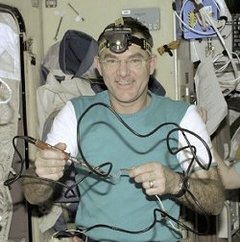
The next crop of astronauts should be tested on their improvisational skills when they are going through the whole NASA testing and stuff. We need some spacemen with major MacGuyver skills while on orbit to be sure. back on Mir, if you didn’t have the ability to make due with what you had on had to solve a problem you were SOL. I’m sure with impending budget cuts to the space program things might prompt some astronauts to get creative to carry out their duties.

[via neat-o-rama and Popular Science Blog]

You can’t go to Home Depot